
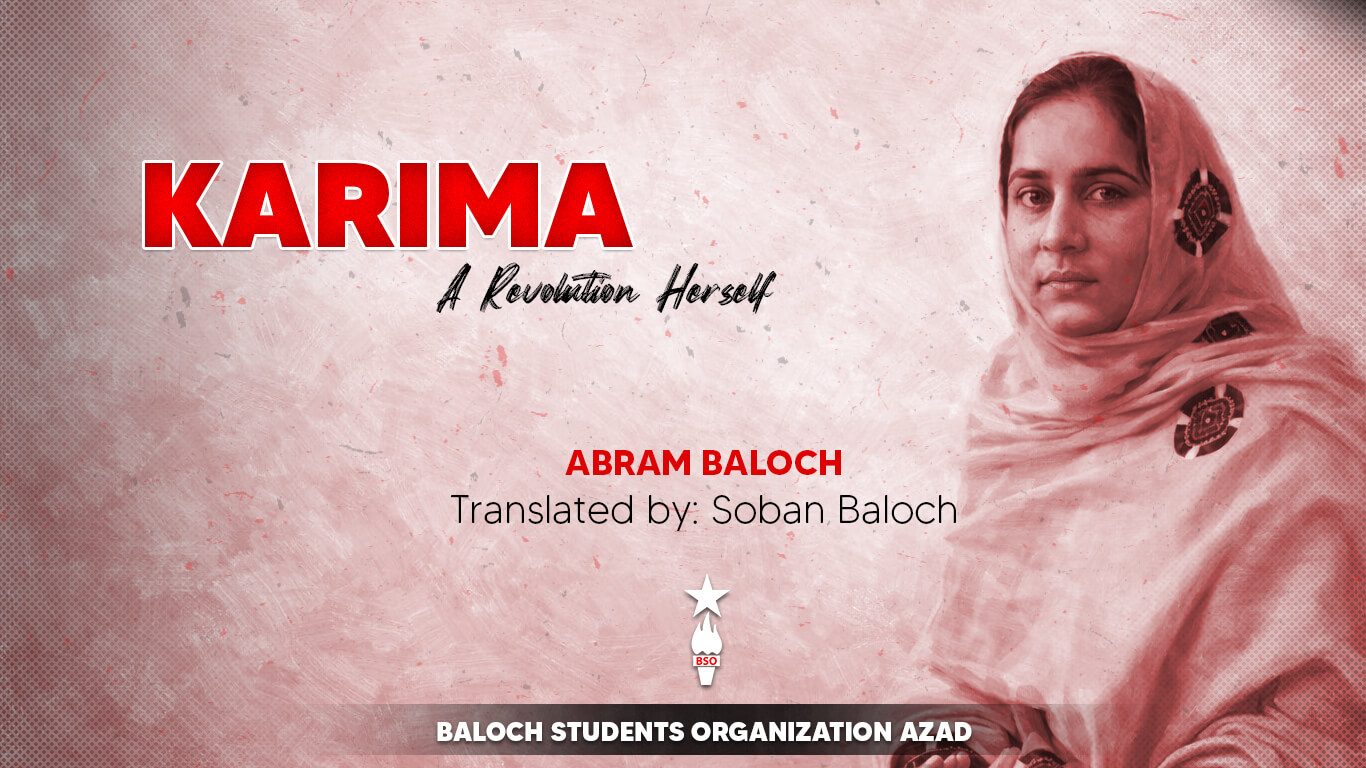
Karima: A Revolution Herself
Abram Baloch
Translated by: Soban Baloch
Writing the foreword to this book is both an honour and a profound test. It is an honour for me to write about a personality like Karima, one endowed with rare divine blessings. Choosing the right words to describe a soul as profoundly gifted as Karima’s is, for me, a severe trial, and an even greater challenge is to do justice to her virtues, her sacrifices, and her revolutionary essence.
Historically, Baloch political leaders have been criticized for failing to document their movements, struggles, and political rise and fall. As a result, the new generation often remains unaware of the methodology, ideology, and intellectual foundations of their leaders. Karima, however, was different. She consistently wrote about her surroundings and the realities unfolding around her. Her writings and speeches speak directly to bereaved mothers and sisters, and to the helpless Baloch people. They stand as testimony to the two-decade-long struggle of the Baloch national movement and shine as a beacon of hope amid the cries echoing from mutilated bodies.
I believe this book serves as a vital political diary for political workers to understand “Karima.” If her writings cannot be categorized strictly as political theory, future forecasting, or formal philosophy, then their very form, whether written or spoken, holds the undeniable status of a political diary within the Baloch national movement. To read and understand the Baloch national movement, reading Karima is indispensable.
Karima’s struggle, along with her writings and speeches, can certainly be subjected to criticism. Yet the same commitment with which she stood firm on her revolutionary principles is reflected in the sincerity with which she wielded her pen and language for the Baloch people. In this sense, she embodied the essence of a true revolutionary. She left behind an inheritance so rich that it can guide coming generations. Not only can future generations draw direction from it, but they can also add their own contributions and play an even greater role in shaping Baloch society.
To understand Karima, one must first feel the bond between blood and soil. One must feel the Baloch people’s boundless love for their land, the selfless devotion to the poor without any expectation of return, the courage to challenge the enemy, the mother who gave birth to Karima, and the home where her revolutionary dreams first took shape.
Karima cannot be understood through words alone; her character must be fully grasped. Each event must be read carefully, one by one. Those sudden and violent occurrences in the Baloch land must be thoughtfully examined.
We must not begin understanding Karima from her birth in 1986, but rather from November 13, 1839, the day Britain occupied Balochistan. We must understand the courage of Mehrab Khan and the Pakistani occupation of Balochistan on March 27, 1948. We must confront the execution of Nooroz Khan’s son before his eyes; the forced disappearance of Baloch women from Kohlu and Kahan in 1973 and their sale in the markets of Lahore; the radioactive nuclear explosions in the beautiful Chagai mountains and the strange diseases that afflicted newborn children; the bombing of innocent women and children in Dera Bugti; the rape of Baloch women by the Pakistani army in Mashkay; the mutilated bodies of forcibly disappeared Baloch people whose organs were sold; the cries of mothers whose sons, daughters, and husbands have been imprisoned for years in torture cells; and the lives of orphaned children. Every tragedy of the Baloch land demands understanding, because Karima emerged from this very soil, shaped by these events, incidents, and characters.
She belonged to a family where children were taught revolution rather than personal comfort, prosperity, or the accumulation of wealth. They were educated to sacrifice themselves for their homeland and nation. Instead of bowing before tyrants and oppressors, they were taught the dignity of offering their lives for their oppressed and helpless people.
Karima opened her eyes in a home where her grandmother tied her headscarf and welcomed the body of a complete revolutionary youth, Dr. Khalid Baloch, with revolutionary slogans instead of a burial shroud, as if Khalid had been born twice. As a young girl, Karima carried the coffin of her uncle-like friend on her shoulders while chanting revolutionary slogans. She grew up in a land where, due to relentless oppression, men were often absent, and women held their ground. Yet she never surrendered. From an early age, she witnessed the bodies of hundreds of relatives and revolutionary comrades. She was never afraid, never weak, and never bowed her head.
When Karima entered politics, she was a young, skilled, and talented woman, fully capable of living a comfortable life. She could have chosen any profession and raised the flag of personal success. But had she chosen comfort over struggle, she would not have become Lumma Karima. Lumma Karima, the faith of an entire revolutionary movement, was born from struggle itself, forged in resistance against national slavery. Revolutionary struggle chooses its own leaders. Born from unbearable circumstances, it demands sacrifice, endurance, and unwavering commitment. Only individuals like Karima can remain steadfast through every trial.
Karima’s revolutionary role, vision, and political maturity cannot be honored merely by romanticizing the past, expressing sympathy, or offering condolences. Such gestures risk closing the deeper paths of her political struggle. She is both our past and our future. Her political life must be read in the context of history as well as what lies ahead, and her revolutionary legacy must be carried forward. Political activists must rise above sentimentality and personal attachments to truly grasp her philosophy of resistance. Her vision is not only to be read and understood, but also to be acted upon.
Karima’s life and struggle, as presented in this book, offer guidance to political workers facing challenges, hardships, and dilemmas. I believe the truest expression of love for Karima is to read her critically, to intensify her struggle with sincerity, to advance it further, and to pass it on to coming generations.
Whether through her writings or her actions, one truth stands clear: there was no gap between her words and deeds. Those who knew her well attest that immense difficulties marked her life. Many would have faltered under such weight, but she faced every challenge alone, as if fighting two battles on the same battlefield, yet her feet never trembled. Most remarkably, she never voiced despair or defeat. She never spoke the language of surrender. Karima was a soul overflowing with courage, passion, and revolutionary spirit.
Because Karima was a revolutionary fighting against colonialism, international recognition and prestigious awards were never meant for her. Had she not stood against colonial domination, powerful institutions or states might have crowned her the “Iron Lady.” But revolutionary lives like Karima’s are not shaped for Nobel or Peace Prizes. While leaders of the so-called developing world are decorated with awards and platforms that elevate their status, leaders like Karima rise from the cries of innocent children, the grief of helpless mothers, the blood of martyrs, and the brutality of oppression. Their legacy is not measured in medals, but in honor and bravery.
From Karima’s struggle, writings, and speeches, one principle emerges with clarity: she believed deeply in Fanon’s philosophy that colonialism cannot be ended through luxury or comfort, but through sacrifice, sweat, and blood. As Fanon writes, colonialism is established through violence and cannot be dismantled by debates or hollow slogans. Karima repeatedly emphasized in her practice and writings that freedom can only be sustained when the stones thrown by the oppressor are returned with resistance.
This book, Lumma, is not merely a revolutionary contribution for BSO Azad, but for the entire Baloch nation. Understanding Banuk Karima’s struggle is essential for political cadres, not partially, not emotionally, but in its full depth, so that this book may serve as an invaluable guide.
Note: This is the foreword of the book Lumma, written by former Chairman of BSO Azad, Abram Baloch, and translated by Soban Baloch.