
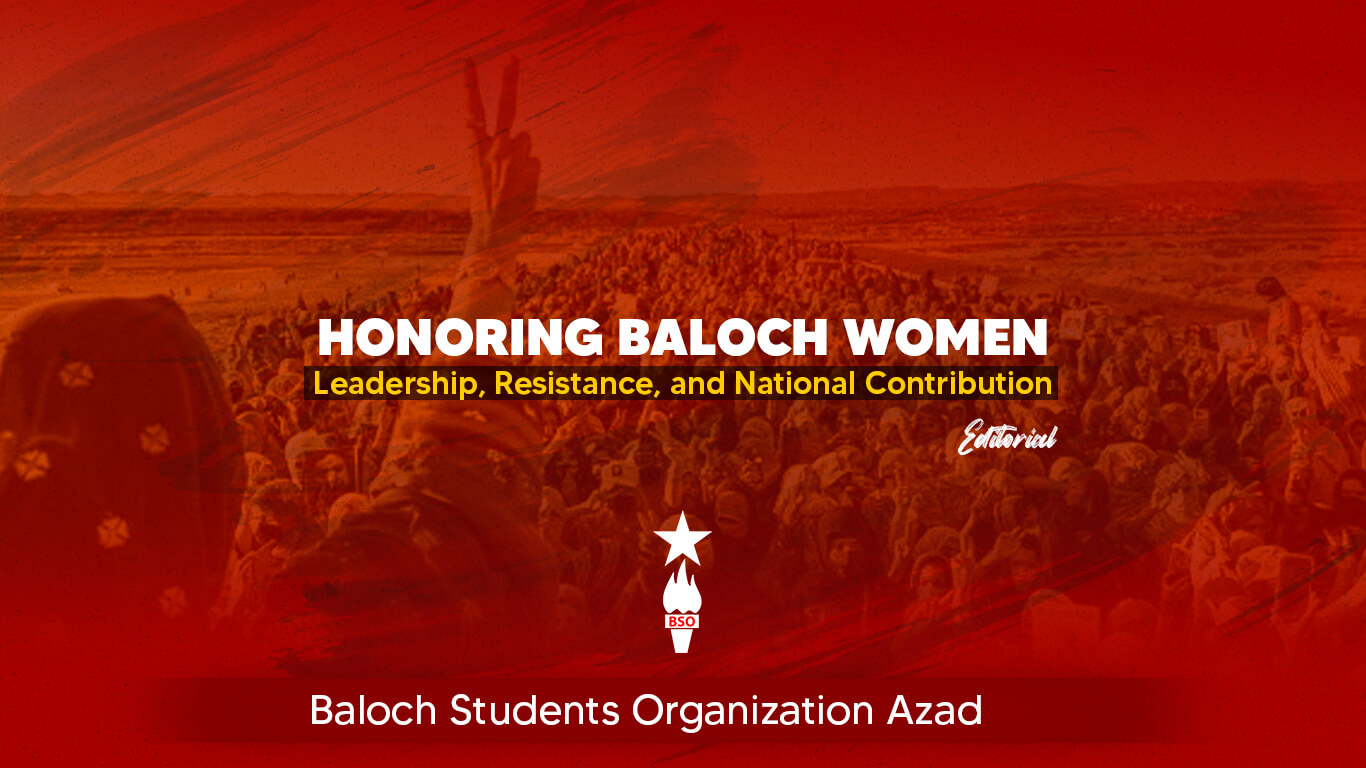
Honoring Baloch Women: Leadership, Resistance, and National Contribution.
Editorial
As every year on 8 March, the world observes International Women’s Day, a day to celebrate women’s achievements and reaffirm the global fight for gender equality. BSO Azad dedicates this day to the resilient Baloch women, who, despite facing relentless state oppression, have always stood firm and contributed selflessly to the Baloch national cause.
International Women’s Day has its roots in protest and resistance. In the early 1900s, women in the United States and Europe began organizing against unfair working conditions and political exclusion. In 1908, thousands of women garment workers marched in New York City, demanding better wages, shorter hours, and the right to vote. The following year, the Socialist Party of America organized the first National Women’s Day. In 1910, Clara Zetkin proposed an international day for women’s rights at the International Socialist Women’s Conference, which laid the foundation for a global celebration of women’s struggles. The date 8 March gained historical significance in 1917, when Russian women marched for “Bread and Peace,” sparking revolutionary change and winning the right to vote. Decades later, in 1975, the United Nations officially recognized the day, transforming it into a global platform to highlight women’s rights and ongoing struggles for equality.
Yet the true spirit of International Women’s Day is found not in ceremonies or speeches, but in the courage of women who confront injustice. Among them are the women of Balochistan, whose bravery has come to define the region’s fight for human rights. Across Pakistan, Iran, and Afghanistan, Baloch communities have endured colonization, political unrest, economic marginalization, and widespread human rights violations. In this environment, Baloch women have refused to remain silent. In recent years, they have entered traditionally male dominated spaces, leading protests, organizing awareness campaigns, and challenging state authority with remarkable courage. Mothers demand answers for missing sons, sisters document abuses, and students raise awareness about human rights violations. This collective effort has transformed personal grief into public resistance, creating a culture of resilience that is deeply rooted in Baloch society.
Among the most inspiring figures is Karima Baloch, the former chairperson of BSO Azad, who spoke fearlessly about the plight of her people on the global stage despite threats and exile, and countless ordinary women who continue to risk their safety for the cause. Lumma Yasmeen and Lumma Lalbibi exemplify this dedication, even sacrificing personal comforts and family for the struggle of national liberation. Their courage shows that the fight for justice is not only political but also it is profoundly human. From mothers holding photographs of disappeared children to young women standing at the forefront of protests, Baloch women have redefined the role of women in the region, proving that resilience, courage, and conviction can thrive even in the harshest circumstances.From being victims to emerging as frontline defenders and influential women leaders, Baloch women have shaped this struggle and garnered remarkable recognition on the international stage. This proves that Baloch women are not only resilient but also an unyielding force for justice and change.On this International Women’s Day, we honor Baloch women, not only for their struggle and sacrifices but for their unwavering spirit,commitment, resilience, and leadership in the face of systemic oppression which demonstrates not only personal courage but also the critical contribution of women in the Liberation movements. Honoring their efforts today underscores the importance of ensuring that women remain central to advocacy, decision-making, and the ongoing pursuit of freedom in Baloch National Movement.