
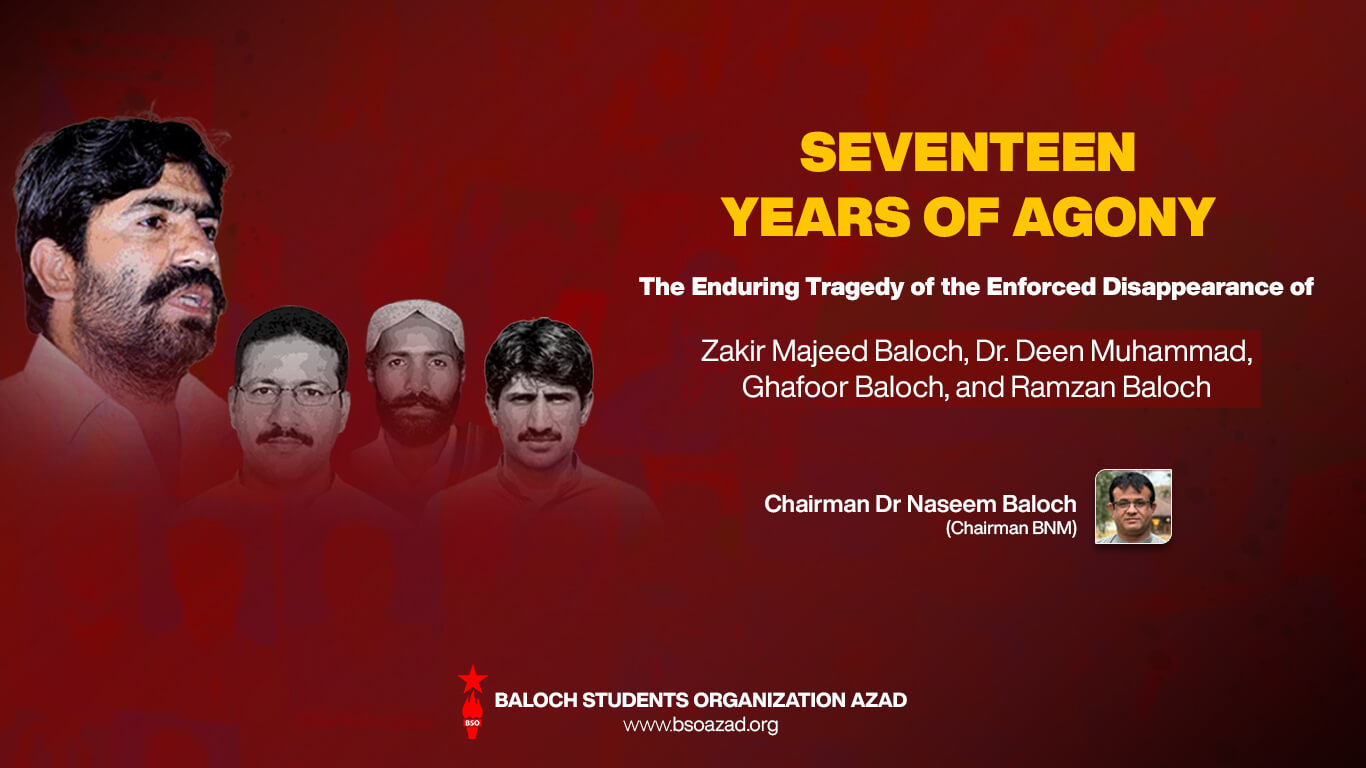
Seventeen Years of Agony: The Enduring Tragedy of the Enforced Disappearance of Zakir Majeed Baloch, Dr. Deen Muhammad, Ghafoor Baloch, and Ramzan Baloch
Chairman Dr Naseem Baloch
June 8 is remembered as one of the most painful and tragic days in the history of Balochistan. On this day in 2009, Zakir Majeed Baloch, the Vice Chairman of the Baloch Students Organization Azad (BSO-Azad), along with two of his companions, was taken from Mastung by personnel of the Pakistani military and intelligence agencies and subsequently subjected to enforced disappearance.
This year marks seventeen years since his enforced disappearance on June 8. Yet, even after all these years, his family and friends remain in complete uncertainty, not knowing whether he is alive or dead.
The name of Zakir Majeed Baloch is no longer merely the identity of an individual; it has become a symbol of resistance and defiance against enforced disappearances in Balochistan. His disappearance did not only devastate his own family, but also came to represent the collective pain and suffering of thousands of Baloch families whose loved ones have been forcibly disappeared under state repression.
Zakir Majeed’s sister, Farzana Majeed, has led a remarkable and rare example of sustained struggle for the recovery of her brother. Alongside the late Mama Qadeer Baloch, the former leader of Voice for Baloch Missing Persons, she participated in the historic long march of approximately 2,500 kilometers on foot, starting from Quetta to Karachi and then continuing from Karachi to Islamabad. Women, elderly people, and children also joined this march. They carried photographs of their missing loved ones, united by a single demand: “Return our loved ones safely.”
However, when this caravan reached Islamabad, those in positions of authority refused to listen to their voices. Their demands were neither taken seriously nor were the wounds of the affected families acknowledged or addressed. This state of indifference further deepened the grief and suffering of the families of the disappeared.
Hamid Mir was the only journalist who invited the activists of the march to his talk show and tried to raise his voice for the missing persons. Soon after sone days, Hamid Mir was shot and injured, but he survived.
Another example of this attitude was witnessed almost a decade later, when the leadership of the Baloch Yakjehti Committee (BYC) arrived in Islamabad to demand the recovery of missing persons. The leadership, including Mahrang Baloch and her companions, was met with water cannons and was forcibly loaded into buses in an attempt to deport them back to Balochistan.
This incident once again made it clear that Balochistan and Pakistan are not the same in any meaningful sense. Neither in terms of rights, nor in administrative structure, nor in cultural or civilizational identity. Balochistan, with its thousands of years of history, civilization, and national identity, represents a distinct and separate entity, whereas Pakistan is a young and unnatural state with a history of seventy-eight years.
During these seventy-eight years, the Bengali nation endured oppression, repression, and systematic attempts to erase its language and culture, and ultimately succeeded in achieving independence from Pakistan in the form of Bangladesh. Similarly, the Baloch nation has continued its resistance against the forced occupation of Balochistan. However, there is a fundamental distinction between the two struggles. The Bengali movement was aimed at separation from Pakistan and the creation of a new state, whereas the Baloch position is that Balochistan was historically an independent and sovereign country which was forcibly occupied by Pakistan, and their struggle is aimed at ending that occupation.
Every nation possesses the fundamental right to freedom. The Baloch nation is also pursuing this right under international principles of self-determination and seeking an end to occupation. Pakistan itself supports the right of the Palestinian people to freedom and calls for an end to Israeli occupation of Palestinian territories, while at the same time maintaining its own occupation over Balochistan. Balochistan constitutes nearly half of Pakistan’s territory, and the nature and scale of this dispute make it one of significant where such a vast land is occupied in the modern era.
For the end of such a vast and prolonged occupation, the Baloch nation requires moral, political, and diplomatic support from the international community. History shows that no occupation is permanent. Even the most powerful military occupations have eventually come to an end. The Soviet intervention in Afghanistan followed by the United States’ military presence, and their eventual withdrawal, as well as the Vietnam War and the American defeat, stand as clear examples that the aspiration for freedom cannot be permanently suppressed through force.
These historical experiences continue to provide hope and strength to the Baloch nation, reinforcing the belief that the current situation in Balochistan will also eventually come to an end. The Baloch people continue their struggle with the conviction that principles of freedom, justice, and self-determination will ultimately prevail, allowing the people of Balochistan to decide their own political future.
Similarly, Dr. Deen Muhammad Baloch, a member of the central committee of the Baloch National Movement (BNM), has been missing since 2009. Dr. Deen Muhammad was a well-known political activist and a medical doctor by profession. He was abducted from his hospital while on duty, and since then, there has been no trace of his whereabouts.
His daughter, Sammi Deen Baloch, is today recognized as a prominent human rights activist.When Dr. Deen Muhammad was forcibly disappeared, Sammi was still a young child. She grew up searching for her father in streets, protest camps, and public spaces. Her entire childhood was shaped by the struggle for his recovery. Even after seventeen years, she continues to stand with the same unanswered question: what was her father’s crime?
Sammi Deen Baloch also participated in the famous long march organized for missing persons. Through her struggle and advocacy for human rights, she was awarded the International Human Rights Award for the Asia-Pacific region in Dublin, Ireland, by Front Line Defenders, and emerged as an influential voice on the global stage. However, despite her personal tragedy, continuous struggle, and international recognition, there has been no change in what she and others describe as Pakistan’s repressive policies.
Ghafoor Baloch is also among those political activists who were forcibly disappeared in 2009. He was a member of the central committee of the Baloch National Movement. For years, his family and friends knocked on doors, approached courts, and organized protests, yet to this day they have received no justice.
Ramzan Baloch, a senior activist of the BNM, has been missing since July 2010. His case is also part of the same ongoing tragedy. His son, Ali Haider Baloch, endured the trauma of his father’s disappearance at a very young age. He too became part of the historic long march led by Mama Qadeer Baloch and Farzana Majeed. Carrying his father’s and other missing persons’ photographs on a hand-pulled cart, he walked from Quetta to Karachi and then to Islamabad, hoping that his voice might reach the corridors of power and lead to the recovery of his father and others.
However, his appeal, like those of countless other Baloch families, was ignored.
Enforced disappearances in Balochistan are not only human rights violations but represent a collective and ongoing tragedy. Over the past two decades, thousands of Baloch political activists, students, teachers, intellectuals, and ordinary civilians have been forcibly disappeared. Many later resurfaced as mutilated bodies, while countless others remain missing to this day.
Within Baloch society, there is a growing perception that living under Pakistani administration means enduring constant fear, insecurity, and oppression. The fear of enforced disappearance has entered nearly every household. Despite being rich in natural resources, the people of Balochistan continue to face deprivation, poverty, and political marginalization. Their resources are controlled, their political voices are suppressed, and their lives remain marked by uncertainty.
On the completion of seventeen years since the disappearance of Zakir Majeed Baloch, Dr. Deen Muhammad Baloch, Ghafoor Baloch, and Ramzan Baloch, the central question remains unanswered: when will justice be delivered? When will these families be informed about the fate of their loved ones? When will the state, in accordance with law and constitution, bring an end to the practice of enforced disappearances?
June 8 is not only a remembrance of a few individuals, but a symbol of the suffering of thousands of families in Balochistan who have waited for years for the return of their loved ones. It serves as a reminder to international human rights organizations, the United Nations, and all voices of conscience that the issue of enforced disappearances in Balochistan remains unresolved, and the struggle of affected families continues.
Seventeen years later, the families of Zakir Majeed Baloch, Dr. Deen Muhammad Baloch, Ghafoor Baloch, and Ramzan Baloch have not abandoned hope. Their hope continues to revolve around the same unanswered question: “Where are our loved ones?”
The continued repression and state policies have further strengthened the belief among the Baloch nation that without the restoration of their national freedom, there can be no alternative path to a dignified, peaceful, and secure life for the people of Balochistan.