
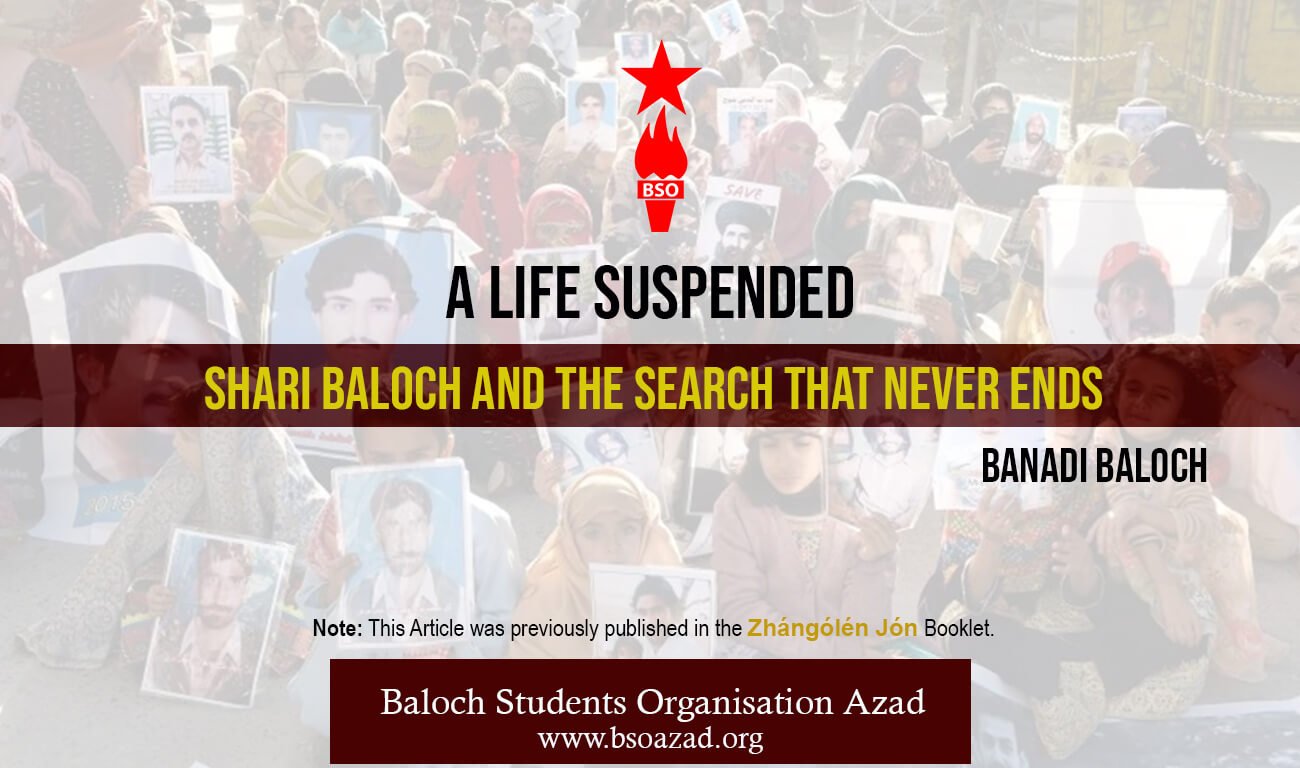
𝐀 𝐋𝐢𝐟𝐞 𝐒𝐮𝐬𝐩𝐞𝐧𝐝𝐞𝐝:
𝐒𝐡𝐚𝐫𝐢 𝐁𝐚𝐥𝐨𝐜𝐡 𝐚𝐧𝐝 𝐭𝐡𝐞 𝐒𝐞𝐚𝐫𝐜𝐡 𝐓𝐡𝐚𝐭 𝐍𝐞𝐯𝐞𝐫 𝐄𝐧𝐝𝐬
𝐁𝐚𝐧𝐚𝐝𝐢 𝐁𝐚𝐥𝐨𝐜𝐡
When Waiting Becomes a Way of Life
For families the pain of losing a loved one starts with something that is certain. There is a phone call, a funeral, a grave and people gather to mourn. Time does not make the pain go away. It helps people learn to live with the loss.
For families of people who are taken away by force the pain is different.
There is no confirmation that the person’s alive or dead. There is no body to bury no funeral to go to and no last goodbye. Instead there is waiting. Days turn into months, months turn into years and years change the family. Every unknown phone call disrupts life. Every knock on the door brings hope. Then there is silence again. Every report of a body found makes families ask the same unbearable question:
“Could it be the person they have been searching for all these years?”
People who study rights often call this experience ambiguous loss. A pain that is suspended between hope and despair. For families who are going through this no definition can fully explain what it is like. Waiting is not just sitting around doing nothing. It takes over life. It changes the conversations people have at the dinner table turns birthdays into reminders of who’s not there and leaves empty chairs that nobody wants to move. Parents get older wondering if they will see their children again. Wives struggle to explain why their husbands are not coming back to their children, who keep asking when their fathers will return. Sisters keep photographs that become older than the memories they hold.
Shari Baloch’s family is one of them.
Her story starts not in a court or at a protest. In a simple family home where she grew up thinking her big brother, Deedag Baloch would always be there to support her. Like younger sisters she looked up to him. In interviews she has said that he was her companion, the person who was happy about her achievements before anyone else and who encouraged her to keep studying. She has said that he was more than a big brother. He was her best friend.
On a day of August 2018 that normal life stopped suddenly.
Shari was fifteen years old. She had just gotten a result in school that she wanted to share with Deedag. She remembered how excited she was to tell him. By the end of the day her family was looking for him.
According to the family Deedag Baloch and Shari’s cousin Bebagar Baloch disappeared after a security operation near Mastung while they were coming back from a picnic with friends. The authorities said the men they took were militants. The family has always said that is not true and has spent years trying to find out where they were taken and what happened to them.
That evening changed every person in the household.
Shari has talked about seeing her father cry for the time. That image has stayed with her. Her mother did not believe that her son could just disappear without a reason. Relatives looked for him in hospitals, police stations, government offices. Asked anyone who might know something. Like other families in the same situation they thought the uncertainty would end in hours or days.
It did not.
The first few weeks were busy. Every phone call seemed important. Every rumor gave them a place to look. Family members traveled from one office to another with pictures of Deedag hoping someone would recognize him or give them a clue about where he was. Every meeting ended with a promise that someone would “look into it.” None of them brought the family closer to finding him.
For Shari childhood ended sooner than she thought.
While her classmates went back to their routines after school holidays she found herself learning a new routine. One that involved waiting, paperwork, legal petitions and unanswered questions. Her days were divided between studying and helping her family search for her brother.
As the months passed the search went beyond police stations and government offices.
Families looking for missing relatives often get called when unknown bodies are found. Someone has to check if the dead person’s a missing son, husband, brother or was through this reality that is went to a morgue for the first time.
She was fifteen years old. In interviews later she remembered seeing a body that was badly damaged she could not look at it anymore.
“I couldn’t look at the c said. “I walked out.”
Outside the building she felt relieved. The body she saw was not her brother.
Years later Shari said that moment has never left her. Feeling relieved in a morgue is something she never thought she would experience. It became part of a reality that many families who are searching for missing relatives share: hoping that every unknown body belongs to someone else while fearing that one day it might not.
The visits to the morgue did not stop. Whenever unknown bodies were found the family kept looking. In one interview Shari talked about how hard it was to recognize bodies that were severely damaged. Sometimes she said, she left wondering if she had unknowingly failed to recognize her brother. That uncertainty became another kind of pain.
Unlike death when someone is taken away by force there is no end. It leaves families stuck between hope and despair to mourn, yet unable to move forward. Every passing year raises questions. Is the missing person alive? If not where are they? If they are alive do they know their family is still looking for them?
For Shari’s family those questions became part of life. Her mother once told her that she was starting to forget Deedag’s smile. His wife kept waiting for a husband who never came back.
His young daughter kept asking the question that nobody in the family could answer:
“When will my father come home?”
Those words are at the center of Shari Baloch’s story. Not because they give answers but because they show the human cost of living without them. The search, for Deedag did not end after weeks or months.
It was only just beginning.
When Muhammad Deedag Baloch disappeared in August 2018 Shari Baloch’s family thought they would get some answers. They went to police stations talked to government people asked lawyers for help and did everything they could think of. Like families who have someone disappear they thought someone must know where Deedag Baloch was and that they would find out what happened to him.
Days turned into weeks.
Weeks became months.
The answers never came.
As time went by Shari Baloch started to understand that when someone disappears it affects the family not just the person who is missing. When people talk about it they often focus on the person who disappeared.The people left behind have to live with a lot of uncertainty and unanswered questions. In interviews Shari Baloch often talks about the people around her not about herself. She talks about her mother, who is struggling to remember things, her father, who’s very sad Deedag Balochs wife who does not know if she is a wife or a widow and Deedag Baloch’s young daughter, who keeps asking about her father.
Shari Baloch once said, “My mother is afraid she is forgetting Deedag Balochs smile.”
This shows how hard it is when someone is gone for a time.
Most families remember things through pictures and stories. Memories change over time.
It gets harder to remember what someone voice sounds is like or what they look like.
The years following Deedag Baloch’s disappearance transformed every aspect of Shari Baloch’s family’s life. As the search continued without answers, the uncertainty began affecting each family member differently. Shari has often explained that enforced disappearance is not experienced only by the person who vanishes; it becomes a burden carried by parents, spouses, siblings and children. Her mother, she has said, fears that the passing years are slowly erasing the memory of her son’s smile. It is a grief that extends beyond absence—the fear that time itself may take away the memories she has struggled to preserve. Meanwhile, Deedag’s daughter continues growing up without knowing where her father is. She repeatedly asks, “When will my father come home?” Shari has admitted that there is no answer gentle enough for a child because the family itself has never been told what happened to him. Years have passed, yet that question continues to echo inside their home.
The search has taken Shari to places no teenager expects to visit. Whenever unidentified bodies are recovered, families of missing persons are often called to help determine whether the deceased could be their loved one. It was through this painful process that Shari entered a morgue for the first time at the age of fifteen. She later recalled that she could not continue looking after seeing the first body and walked outside. In another interview, she reflected on what has become one of the most haunting parts of her search: the fear that severe disfigurement could prevent her from recognizing her own brother.
“When I visit the morgue to identify whether the mutilated body is that of my brother Deedag Baloch or my cousin Bebagar Baloch, I’m often unable to do so because of the severe disfigurement,” she said. “The uncertainty haunts me, leaving me wondering if I mistakenly failed to identify my own brother.”
For Shari, every visit to the morgue ends not with certainty but with another layer of doubt, illustrating how enforced disappearance denies families both closure and the ability to grieve.
Unlike families who receive confirmation of a loved one’s death, those searching for the disappeared remain suspended between hope and fear. Shari has described this as living in “a state of perpetual uncertainty.” In her family’s home, life has continued, but it has never returned to what it once was. Eid is still celebrated, but there is an empty place at the table. Family gatherings continue, yet Deedag’s absence remains part of every conversation. His daughter is growing older without him, his wife continues waiting, and his parents continue searching for answers. The years have moved forward, but for the family, the uncertainty has remained unchanged.
As the search continued, Shari realized that her family’s experience was shared by many others. The demonstrations she attended introduced her to mothers, fathers, sisters, wives and children who had spent years searching for loved ones. Some families had been waiting for only a few years, while others had lived with uncertainty for decades. Each family carried photographs, legal documents, petitions and court records—the evidence of years spent searching through every possible channel. Despite coming from different towns and backgrounds, their conversations revolved around the same unanswered questions: Who last saw them? Which office had they visited? Which court had they approached? Had anyone received any new information? Listening to these stories changed Shari’s understanding of her own loss. She realized she was not only searching for her brother; she had become part of a much larger community of families living with the same uncertainty.
Before her brother disappeared, Shari had imagined a very different future for herself. She was a schoolgirl focused on her studies, not someone who expected to speak publicly about human rights or appear in interviews. As the years passed without answers, however, she concluded that remaining silent would not bring her brother home. Speaking publicly became another way of continuing the search. She has often explained that she did not choose this role; rather, it emerged from years of waiting and unanswered questions. Through interviews and public events, she began sharing not only her brother’s story but also the experiences of countless other families whose lives had been disrupted by enforced disappearance.
Despite becoming a public voice, Shari consistently brings the conversation back to family. Rather than describing Deedag only as a missing person, she remembers him as the brother who encouraged her education, celebrated her achievements and believed in her future. She reminds audiences that every photograph carried during a demonstration represents a person who once lived an ordinary life, shared meals with family, celebrated birthdays, made plans and dreamed about the future. By telling these stories, she seeks to preserve the humanity of those who are often reduced to case numbers or statistics.
Today, more than seven years after Deedag’s disappearance, the search continues. The family still waits for answers. His daughter has grown older, his parents continue hoping, and his wife continues living between hope and uncertainty. Looking back, Shari says that the search has never been only about finding her brother. It has also been about ensuring that his name is remembered and that the years of waiting endured by her family—and by countless other families searching for missing loved ones—are not forgotten. For families living with enforced disappearance, time does not end the search. Instead, it teaches them how to carry uncertainty while continuing to hope for the day when their questions may finally be answered.
𝗡𝗼𝘁𝗲: 𝗧𝗵𝗶𝘀 𝗔𝗿𝘁𝗶𝗰𝗹𝗲 𝘄𝗮𝘀 𝗽𝗿𝗲𝘃𝗶𝗼𝘂𝘀𝗹𝘆 𝗽𝘂𝗯𝗹𝗶𝘀𝗵𝗲𝗱 𝗶𝗻 𝘁𝗵𝗲 𝗭𝗵á𝗻𝗴ó𝗹é𝗻 𝗝ó𝗻 𝗕𝗼𝗼𝗸𝗹𝗲𝘁.