
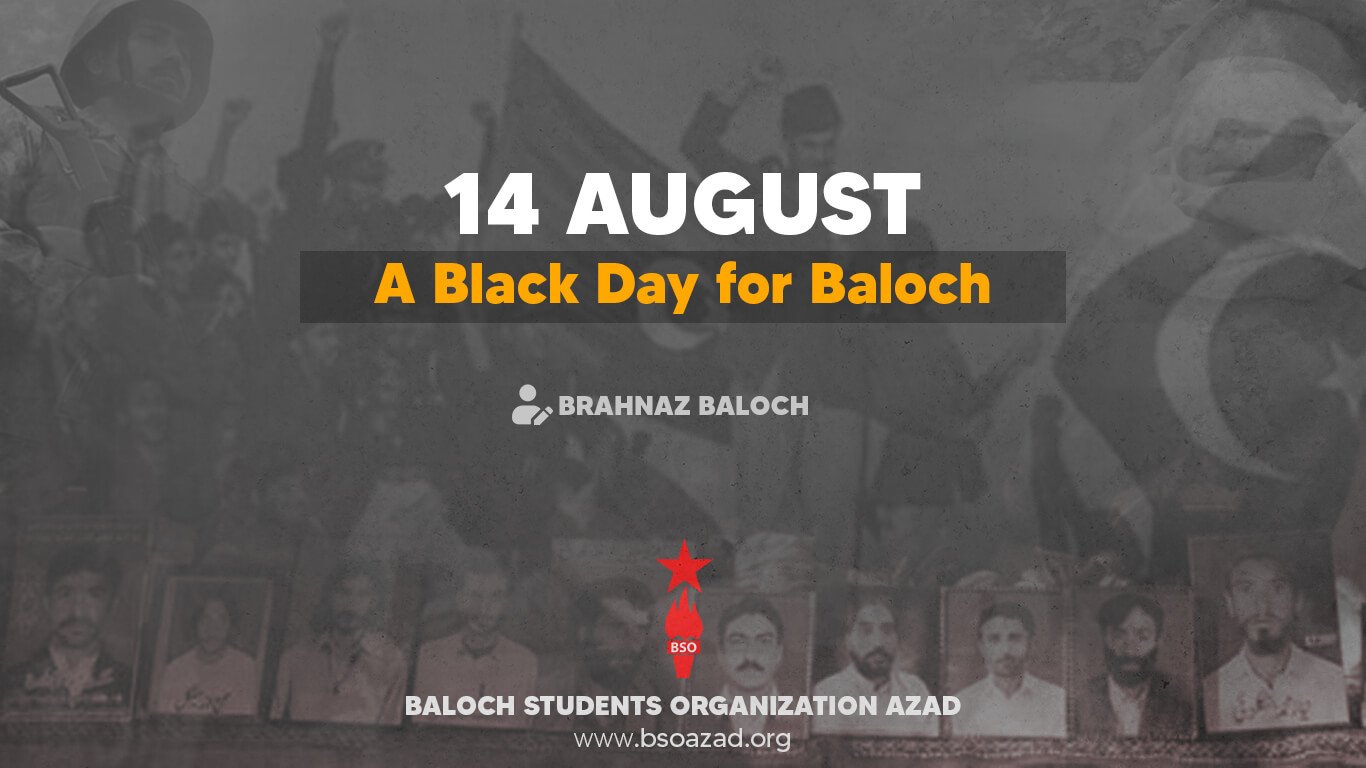
14 August: A Black Day for Baloch
Brahnaz Baloch
A day comes bringing happiness for some where folks participate enthusiastically while for some this day is shrouded with darkness, hearts echoes remembering their beloved ones. This is how for most people in Pakistan, 14 August arrives with the colours of celebration. Streets are covered with flags, children wear green and white dresses. Schools echo with songs and speeches about freedom. Homes are decorated and the memory of 1947 is carried like a story of birth.
But history is rarely a single story. A date that brings joy to one person can awaken grief in another. A “freedom” celebrated by some can be remembered as the beginning of an unresolved question by others. For Baloch people, 14 August is not a day of celebration. It is observed as a Black Day. Not because they do not understand the meaning of freedom but because their understanding of freedom has been shaped by a different history. It is a day of remembrance, a day of grief. A day to ask what independence means when a people still feel that their political voice has not been heard. Perhaps this is the strange cruelty of history. The calendar gives everyone the same date but not the same memory.
When Independence has different meanings;
The creation of Pakistan in 1947 was one of the great turning points of South Asian history. The creation of Pakistan and artificial demarcation by British colonial empire created a series of conflicts, neglecting the national questions in the region and creating chaos which is continued till today. Yet the story of Balochistan during those years was far more complicated than a simple narrative of independence. The region consisted of different political and administrative territories. Among them was the Khanate of Kalat. The relationship between these territories and the newly created Pakistani state became a matter of political disagreement and conflict. For many Baloch nationalists, this history is not buried in the past. It remains alive in their political consciousness. They believe that the political aspirations of the Baloch nation were not adequately respected and that the relationship between Balochistan and the Pakistani state began with unresolved questions.
That is why 14 August carries a different meaning for Baloch. When others see a flag, they may see freedom. When others hear the word independence they may hear the birth of a state. But Baloch hear the echo of another story. A story of a homeland struggling to define its place in the world, a story of political repression. A story of wounds that never fully became history because they continued to live in the present. This is what makes the word Black meaningful. Black is the colour of mourning. It is the colour of memory when memory refuses to disappear. It is a quiet way of saying that while some people celebrate one history, there are people still carrying another.
The Wounds of Balochistan
Since the creation of Pakistan, Balochistan has passed through repeated periods of political repression and violence in hands of Pakistan. Different movements have emerged with different demands. Some have sought greater autonomy and political rights while others have demanded more radical forms of change. But behind every political movements there are human beings. History often speaks in the language of movements and governments. Ordinary people experience it through empty chairs at dinner tables. A political conflict is not simply a line in a history book when a mother waits for her son. It is not an abstract question when a family loses its home. It is not merely a statistic when a child grows up without a parent. The issue of missing persons has therefore become one of the deepest wounds in Baloch society. Families have spent years asking where their loved ones are. They have stood in streets and camps carrying photographs and names.
For them the question is painfully simple:
Where is my son, daughter, father or brother?
No political argument can make that question insignificant. At the same time Pakistan has faced serious resistance from armed groups operating in Balochistan. Civilians and security personnel have lost their lives. People have lived under the shadow of violence. The tragedy is that ordinary people are often caught between forces much larger than themselves. A mother does not care which political theory caused her son to disappear. A child does not understand the language of insurgency or counterinsurgency. They only understand absence. And absence has its own language. This is why any future for Balochistan must reject violence against civilians from every side. A society cannot heal by creating new graves while mourning the old ones.
A land, rich in resources and poor in accessing, Balochistan is vast and beautiful. It possesses mountains that seem to touch the sky and a coastline that opens towards the ocean. Beneath its soil lie gas and minerals, copper and gold. Its geographical position gives it immense strategic importance. Yet the wealth of the land does not always appear in the lives of its people. In many parts of Balochistan poverty remains a reality, unemployment remains high. Schools and hospitals remain insufficient in throughout the region. Basic facilities that should be ordinary are still treated as privileges. And so, a question continues to rise from the land: If Balochistan is rich then why are so many of its people poor?
This question is more than an economic question. It is a question of colonialism.
People do not simply want development to arrive on their land. They want to be part of the decisions that shape their future. They want to develop their land by themselves. They want their resources to improve the lives of their people. They want development to mean more than roads crossing their mountains or projects rising on their soil. Development without freedom can feel like progress happening to people rather than progress happening for them.
A road cannot replace dignity.
A project cannot replace a political voice.
A building cannot replace justice.
And so-called development by outsiders can’t get them freedom.
The Soul of the People
The Baloch question is not only about politics, it is about identity and freedom.
Every person carries a memory. Sometimes that memory lives in books and sometimes it lives in songs. Sometimes it survives in the stories told by grandparents to children. Balochistan has its own languages and traditions. Balochi and Brahui carry generations of memories. Its poetry carries the voices of mountains and deserts. Its music carries stories of love and loss. Its traditions connect the present with a past that refuses to vanish. To lose a language is not merely to lose words. It is to lose a particular way of seeing the world. That is why Baloch poets and writers have often turned to poetry when politics became too heavy for ordinary language. Poetry gives pain a voice, it gives exile a home. It gives memory a place to breathe.
The mountains of Balochistan have therefore become more than geography. In the imagination of its people they are witnesses. They have seen generations rise and disappear. They have watched political borders change while the land remained. Perhaps this is why the Baloch relationship with the land is so deeply emotional. The land is not merely territory. It is a memory, it is identity and it is home.
Why 14 August became a Black Day?
For those who observe 14 August as a Black Day, the date represents an unresolved historical memory. They do not see the story of independence in this. They believe that the national narrative often leaves little room for the Baloch experience. Their remembrance therefore becomes a form of resistance against forgetting. Black Day is not simply about wearing black. It is about remembering what celebration can sometimes hide. It is about asking whether a state celebrating, what the colonised people feel and suffer?
It is about questioning whether independence to someone has any meaning to others who suffer? Their basic human and political rights remain contested. And perhaps most importantly it is about refusing to allow pain to disappear simply because the rest of the country is celebrating.
Yet it would also be unfair to suggest that every Baloch person shares the same political belief. Baloch society has been divided by colonial Pakistani state through languages, religion, regions, political parties and other tactics to rule easily without a greater resistance.
There are Baloch people who were forced or connected in form of greed or personal interests, and are aligned with Pakistan. There are those who believe in occupying state’s parliamentary system, although the experiences have not gone smooth and the government has been puppet since beginning. There are those who resist the colonialism and want to restore their independent state. There are people whose political opinions exist somewhere between these positions. A people cannot be reduced to one political slogan because of the decades long colonial soft policies. To understand Balochistan honestly means allowing its people to speak in their own voices. The state of Pakistan also feels uncertainty and challenges in holding its colonial rule.
Armed resistance has been active since beginning but it rapidly grew in the beginning of 21st century. They have been carrying out attacks against Pakistani state, targeting economic interests, state exploitation projects, international investments, and security personnel. In reaction the state has been targeting political space and using violence against them, targeting them of enforced disappearances, intimidation, illegal detention, harassment, kill and dump and other form of violence which didn’t solve the issue rather grew it more.
This has led the society where political space seems nonexistent. And people are losing any hope but the resistance and fighting the colonialism in any effective form. A space where in the name of security, people are suppressed, and their lives become just a trauma.
This needs, a space where political disagreement does not automatically become treason and where resistance does not automatically become violence. This requires dialogue, not the dialogue performed for cameras, not the dialogue that begins with conclusions already written. Real dialogues mean listening and giving justice. But the dialogues with the political entity doesn’t seem possible by the colonial system. As the Palestinian writer Ghassan Kanafani once wrote, “the negotiations with colonial power means the negotiations between sword and the nick.” The colonial power doesn’t believe in negotiation until they are totally lost.
The Question of Justice
Justice is not only about punishment. Sometimes justice begins with listening. A family waiting for a missing relative deserves an answer. A civilian deserves security and basic human rights protection. A young person deserves education. A worker deserves an opportunity to feed his/her family. A nation deserves a meaningful voice in decisions concerning to its land. These are not extraordinary demands, but are human demands. Balochistan does not need any buildings, structural “development”, nor any fabricated stories and fake trust.
Beyond the Black Day
For Baloch people 14 August is a reminder of unresolved questions. It carries memories of political struggle. It carries the grief of families who have lost loved ones. It carries the anxiety of those who wait for answers. It carries the frustration of the people that feel deprived of the wealth beneath their own soil. But beneath all of this there is also a hope. The hope to live with dignity. The hope to speak without fear, to see children educated rather than forgotten. The hope that the resources of the land will bring prosperity to the people who live upon it. The hope that identity will not have to be defended through suffering. The hope that their land will be liberated from the colonialism.
The land will continue to speak through the voice of resistance. These days of oppression will be vanished and a liberated Baloch land will surface in the global map. The people of that land will not only love each other and live peacefully but love and respect the humanity.