
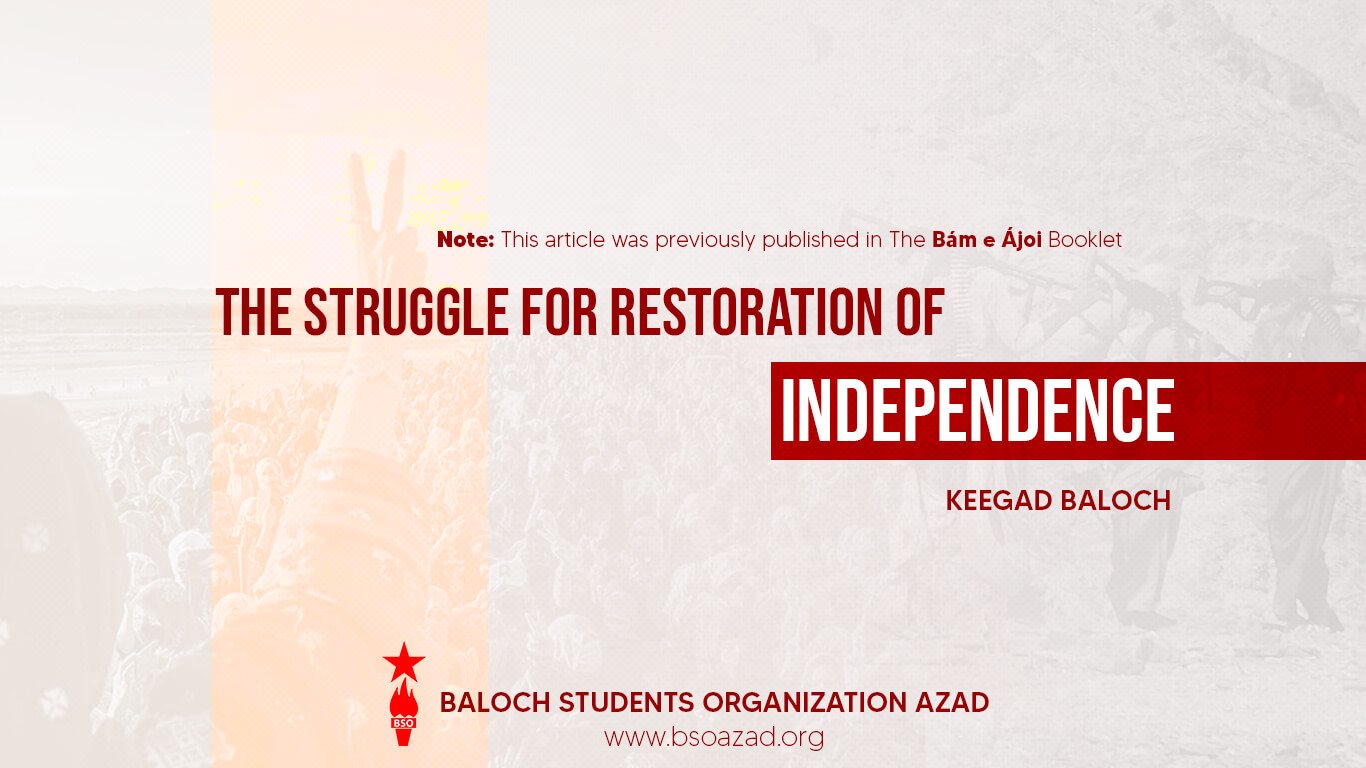
The Struggle for Restoration of Independence
Kegad Baloch
Introduction
The history of the Baloch national question cannot be understood simply as a conflict that began with the creation of unnatural state of Pakistan in August 1947. Its roots extend much further into the political history of the Baloch nation, the Khanate of Kalat, British colonial expansion, the emergence of modern Baloch nationalism, the political transformations that accompanied the British withdrawal from the Indian subcontinent, formation of a client state like Pakistan, its forceful occupation of the Baloch land and the resistance movements carried out by the Baloch people against Pakistan’s colonialism.
Among all this, our central historical narrative is the repeated loss and attempted restoration of political sovereignty and complete independence of Balochistan. The British conquest of Kalat in 1839 is regarded as the first major rupture in Baloch sovereignty, while the occupation of Kalat by Pakistan in 1948 is regarded as a second. Between these two events, however, a modern Baloch political consciousness developed, producing political organisations, intellectual movements and demands for national self-determination.
The events surrounding 1947–48 remain particularly cardinal, as they shape the contemporary Baloch national movement. As per Naseer Dashti, the end of British paramountcy restored Kalat’s sovereignty and later the forceful incorporation of Kalat into Pakistan was an act of coercive occupation. This
Occupation was welcomed with armed struggle and resistance at the same time which certainly proves the Pakistani bogus narrative of accession to be fallacious.
Understanding this history therefore requires a substantive study over Balochistan’s historical Background of sovereignty, the misleading claims made by the colonial state of Pakistan and the present-day struggle to regain the independence of Balochistan.
The Foundations of Baloch Political Identity
The Baloch territories historically extended far beyond the boundaries of the present-day Balochistan, (the region occupied by Pakistan), while the Baloch land and political territories are developed across areas that today are occupied by Iran and Afghanistan too. Over centuries, different tribal confederations and political authorities emerged in the region. The Khanate of Kalat eventually became the principal political center of a broader Baloch political order.
The importance of Kalat in Baloch history lies not simply in its territorial extent but in its political symbolism. It represented an indigenous political authority that existed before the establishment of British colonial rule over the region.
The Baloch political system, however, was not a modern nation-state in the contemporary European sense but consisted of tribal, territorial and political relationships that changed over time and reflected similar to a functioning and nation-state. Nevertheless, the memory of Kalat as a center of Baloch political authority is an important foundation for modern Baloch nationalism.
British Expansion and the First Loss of Sovereignty
British imperial expansion into Balochistan accelerated during the nineteenth century. Balochistan was strategically important because it lay between British India, Afghanistan and Persia and provided routes toward the Arabian Sea and the wider geopolitical frontier of British India. The First Anglo-Afghan War brought the British directly into conflict with the Khanate of Kalat.
In 1839, British forces attacked Kalat. Khan Mehrab Khan was martyred during the assault, He probably knew the fate, but resisted until his last breath. This represents the resistive behavior of Baloch leadership, who never accepted slavery and occupation, rather resist every sort of colonialism and till date, Baloch nation is resisting against the colonial rule of Pakistan. However, this conflict was marked as the beginning of the first major loss of Baloch sovereignty to British imperial power.
British control subsequently developed through a combination of direct administration, treaties, political agents, leases and indirect rule which produced a complicated political structure in Balochistan. Not all Baloch territories were administered in the same way. Some were directly controlled by the British, some were associated with the Khanate of Kalat, and others developed separate political arrangements under British paramountcy.
The British therefore did not simply create a single political unit called Balochistan. Instead, they administered the region through a fragmented colonial structure, with the policy of divide and rule. This fragmentation became extremely important as it reflected different colonial policies over Baloch people and their land. The core idea was simply not to let the Baloch unite during British rule, so that its occupation persisted better. This political crisis surrounding Balochistan also became a reason for the events of 1947–48.
Colonial Rule and the Development of Modern Baloch Nationalism
The emergence of modern Baloch nationalism occurred during the late British colonial period. Baloch intellectuals and political activists increasingly resisted colonial rule, political repression, inadequate education and the traditional concentration of power in state backed tribal elites. Among the important early organizations was the Anjuman-e-Ittehad-e-Balochan, associated with political figures such as Yousaf Aziz Magsi and Abdul Aziz Kurd. The movement sought greater political unity among the Baloch, de-colonial education and political rights to claim the sovereignty of Balochistan.
In 1937, the Kalat State National Party emerged as an important political organisation. Figures including Abdul Aziz Kurd, Ghaus Bakhsh Bizenjo and Mir Gul Khan Nasir became associated with the developing nationalist political tradition. This period is significant because it demonstrates that Baloch nationalism did not suddenly emerge as a reaction to Pakistan, rather a political consciousness demanding self-determination and recognition of Baloch political identity had already developed under British rule.The nationalist movement therefore entered the 1940s with its own political history and organizational traditions.
The Second World War and the End of British Rule
The Second World War severely weakened Britain economically and politically. By the middle of the 1940s, British withdrawal from the Indian subcontinent had become increasingly inevitable.
The approaching end of British rule created an unresolved question concerning the princely states and territories whose relationship was with the British Crown rather than directly with British India. This question was particularly important for Kalat.
The Khanate relationship with Britain was based on treaties and that the end of British paramountcy would terminate those obligations, this meant that Kalat would recover its independent political status after Britain withdrew and so that happened later. While, the colonial state of Pakistan regarded the political future of the princely states within the context of the partition of British India and the accession of states to either India or Pakistan, which is mendacious and a fabricated narrative, aimed to manipulate the truth behind forcefully occupying Balochistan.
Thus, the political disagreement that emerged in 1947 was not simply about geography. It was fundamentally a disagreement about sovereignty and the constitutional status of Kalat.
1947: British Withdrawal and the Sovereignty of Kalat
The Indian Independence Act of 1947 brought British rule in India to an end. This resulted in the formation of an unnatural state based on so-called Islamic principles, while reality reveals nothing else but a regime that would serve the colonial British interests in this region. Since then, this state of Pakistan has been a terrorist state in the region, surpassing human rights, practicing Genocide and being a home for internationally recognized terrorist organisations.
The end of British paramountcy created a new political environment in which the Khanate of Kalat asserted its separate political status.
The date 11 August 1947 occupies a particularly important place in Baloch nationalist memory.
A Standstill Agreement was reached between Kalat and Pakistan to preserve existing arrangements while negotiations continued. This period was an evidence that Kalat possessed a distinct political status and that Pakistan initially dealt with it separately. But the lust for Balochistan’s exclusive resources and strategic geography brought the immoral state to forcibly occupy Balochistan.
Therefore, the events of August 1947 are understood as the beginning of a major political dispute in the region after the withdrawal of British.
The Kalat Parliament and the Question of accession
The political future of Kalat became the subject of debate within the state’s political institutions.
The Khanate had a bicameral legislative structure consisting of the Diwan-e-Aam and Diwan-e-Khas. These meetings debated majorly on the question of accession and the construction of newly formed state of Balochistan. During which, there was strong opposition to accession rather a strong will for restoration of Baloch state was represented by majority.
Ghaus Bakhsh Bizenjo became one of the most prominent voices articulating the nationalist position. He argued that the fact that the population of Kalat was overwhelmingly Muslim did not by itself determine the state’s political future. For Bizenjo and other nationalists, political identity, sovereignty and the right of the people to determine their future were separate questions from religious affiliation.
This represented an important ideological principle in modern Baloch nationalism:
Muslim identity did not necessarily mean that Baloch political sovereignty had to be surrendered to another newly formed state.
March 1948: The Forceful Occupation
The crisis reached its decisive stage in March 1948. On 27 March 1948, Kalat was ambushed with military operations, the region was seized and Khan of Kalat was forced to sign an Instrument of annexation to Pakistan.
The Khan was subjected to intense political and military pressure and that the circumstances surrounding the annexation prevented it from being a genuinely voluntary act. The sovereignty of Balochistan was taken through coercion which is described as occupation rather than an accession.
Consequently, March 1948 reflects the period of occupation, Balochistan once again lost its sovereignty under colonizers, but instead of a surrender, the Baloch movement once again rose with the waves of resistance.
Prince Abdul Karim and the First Post-1947 Resistance
The forcible occupation was never acceptable for the Baloch, as a result Prince Abdul Karim, openly rejected the settlement and moved toward Afghanistan, where he attempted to organize resistance. His movement became the first major armed Baloch resistance against Pakistan after independence.
Although militarily limited, its historical significance is always considerable. It demonstrated that the political dispute surrounding Kalat’s annexation had not been resolved simply through the signing of an Instrument of Accession.
A pattern began to emerge that recurred throughout Balochistan’s subsequent history:
The pattern of resistance and completely denying the treaty of accession. This phase of resistance gave birth to a broader struggle that continues with the same objectives, to regain the independence of Balochistan.
The 1958–59 Uprising
Political tensions intensified during the late 1950s. The centralization of power under Iskander Mirza and subsequently General Ayub Khan, combined with disputes over provincial autonomy and the treatment of nationalist leaders, produced another major confrontation.
In 1958–59, armed resistance broke out in Balochistan. The conflict demonstrated that the 1948 resistance had not been an isolated event. This wasn’t merely the political grievances surrounding centralization but the Baloch national question which continued to generate resistance.
The 1960s and Sher Mohammad Marri
The 1960s saw another phase of armed Baloch resistance, particularly with Sher Mohammad Marri that operated in the Marri and surrounding areas through his armed organization, BPLF. Guerrilla resistance developed in mountainous areas, making military suppression difficult.
Eventually, the Baloch struggle took a new shift in performing guerilla operations, this brought intensity to the conflict but the underlying political question still remained unresolved. This duration became more important as Baloch student’s politics emerged, Although, student organization faced numerous problems while establishing itself but it became successful in creating a platform for youth to resist against the colonial rule.
The End of One Unit and the Fantasy for Provincial Politics
In 1970, One Unit was abolished. Balochistan became a separate province in Pakistani state setup. Although for opportunistic people, this created possibilities for parliamentary politics but on the other side, the struggle for National Liberation continued firmly which openly rejected the idea of parliamentary politics. The National Awami Party (NAP) became an important political force in Balochistan. Few Baloch nationalist entered the parliamentary system and sought to pursue their political objectives through constitutional institutions but failed, because no resistance can be performed while accepting the occupier’s political system, this was an illusion for those people who claimed to work within the oppressor political set-up.
This period is essential for understanding the Baloch national movement because it demonstrates that the idea for parliamentary politics is just a thought in vain.
The 1973–77-Armed Struggle
The most extensive pre-2000 Baloch phase of resistance occurred during the 1970s.
The NAP-led provincial government came into conflict with the federal government. In 1973, the federal government dismissed the Balochistan provincial government.
The dismissal along with the previously unresolved question of Baloch Nation became one of the immediate triggers of a major armed resistance. Thousands of fighters participated in the resistance, particularly in Marri and Mengal areas while the Pakistani Army conducted extensive military operations along with human rights abuses. Iran also supported Pakistan militarily because the Iranian government feared that Baloch nationalism could spread across the so-called border into Iranian occupied Balochistan.
The conflict continued for several years, which intensified the National struggle. A more refined form of resistance was being shaped at this period, the political experiences of Baloch leadership was maturing, the objectives of national struggle were being formed and later years proved to be the stronger period in Baloch national struggle.
The 1990s and the Rise of a New phase in resistance
The 1990s witnessed the emergence of a younger generation of Baloch activists. Students became increasingly important in political mobilization. Baloch student organisations helped connect political nationalism in a more scientific form, the idea of organizational politics along with valid political management came into being. The nationalist movement gradually became less dependent on traditional tribal leadership. Students, intellectuals, writers, professionals and sharper activists became increasingly visible and leading the movement. Baba Khair Bux, along with his companions was generating a stronger platform for armed struggle during his exile, his return to Balochistan later brought a transforming energy to the movement. Baloch Liberation Army emerged as a prominent organization at this period. While other Baloch leadership were also organising political platforms to give a new shape to the Baloch National movement. This generational transformation became particularly important after 2000.
The Renewed phase of Resistance, Post-2000s
The beginning of the twenty-first century witnessed another major improvement in Baloch National Struggle. Baloch National movement was being more nourished with greater political thought, clear ideology and organisational strategies. Armed organizations including the Baloch Liberation Army, Balochistan Liberation Front and Baloch Republican Army (BRA) became prominent. While BSO Azad emerged as an independent student organization, with a clear stance of resisting against Pakistani colonial rule. Later, under the leadership of Chairman Ghulam Mohmmad Baloch, Baloch National Movement’s formation brought another privilege to the movement. Nationalist politics became increasingly significant with the core idea to diminish Pakistani rule in Balochistan and regain the sovereignty.
The struggle expanded beyond traditional tribal politics and became connected with a broader nationalist narrative concerning scientific methods of resistance. Post 2000s holds a significant memory in Baloch history and till date this phase of resistance continues.
The Transformation of Resistance under Pakistans hard policies
During the 2000s and 2010s, the Pakistani state intensified its crimes in Balochistan, issues of missing persons, kill and dump policy, mass displacement, resource exploitation, and other hard policies became increasingly central to Baloch political mobilization. As the immoral state continued its crimes in Balochistan, the resistance against it became more resilient.
Families of missing people began organizing campaigns demanding information about their relatives. Organizations such as the Voice for Baloch Missing Persons became prominent in this struggle. The movement increasingly shifted to highlight Pakistan’s crime and expose its fascist behavior to the world.
This represented a major transformation of Baloch political mobilization. Political organizations were blacklisted, student leadership were detained and made victim of enforced disappearances, and innocent people were targeted in armed encounters by Pakistani state. A series of never-ending genocidal policies were being practiced in Balochistan and yet the world kept its eye blindfolded. Nothing led to the diminishing of National struggle, more the Pakistani state committed crimes, more the Baloch political organizations resisted. Despite, a major crackdown over political workers and organizations, The Baloch struggle continues with unwavering determination till date.
The contemporary Baloch National Struggle
Today, the Baloch struggle has emerged as a prominent and strong anti-colonial movement. From initial phases of resistance to organizing for national cause, this entire historical memory has witnessed the stronger era of resistance at this period. Today, the contemporary Baloch national struggle has increasingly developed into a multidimensional movement involving armed resistance, political activism, students’ mobilization, human-rights campaigns and mass civil resistance. During this period, the issue of enforced disappearances became one of the central issue of Baloch society, with families of missing persons organizing protests, hunger strikes and campaigns demanding the recovery of their loved ones. Widespread disappearances, extrajudicial killings and “kill and dump” policy are being practiced. The killing and disappearance of activists, students and political workers, restrictions on political activity, and the continuing militarization of large parts of Baloch land further contribute to expose Pakistan’s colonial relationship with Balochistan. At the same time, armed organizations such as the Balochistan Liberation Front, Baloch Liberation Army and Baloch Republican Guard have continued to be more powerful, with improving tactics and strategies, along with practices relating to hybrid warfare against the colonial Pakistani state. While peaceful activism, highlighting the Pakistani crimes emerged with great importance. The Baloch Long March of 2023–24 marked an important moment in this development, as protesters travelled from Balochistan towards Islamabad to highlight enforced disappearances, extrajudicial killings and other state crimes. The subsequent mobilization of the Baloch Yakjehti Committee, particularly under Mahrang Baloch, presented the anger of Baloch people against Pakistan’s brutal policies, and a rejection to its genocidal policies. The Baloch Raji Muchi in Gwadar in 2024 brought questions of political rights, militarization, resource control and economic exclusion into the center of public debate. Today, the behavior of Pakistan even on peaceful activism represents its colonial face who cannot tolerate the rise of Baloch people in any form of resistance.
Economic and resource control remain equally important in the contemporary struggle. Balochistan’s natural resources, strategic coastline and mineral wealth have made projects such as Reko Diq, Saindak, Gwadar and the China-Pakistan Economic Corridor central points of political contention. The major question is not simply whether development should occur, but who controls the land and resources, who makes decisions concerning their exploitation, and whether the Baloch, itself is willing to share their resources. The Pakistani state presents CPEC, Gwadar and mineral development as opportunities for modernization which is nothing but pure exploitation of Baloch land and resources without the consent of Baloch and Baloch have been resisting this exploitation from every means. Thus, the contemporary Baloch National struggle continues to strengthen with wide participation from the Baloch people. Pakistan’s colonial policies can surely never dismantle the Baloch struggle, as the struggle in Baloch National struggle is inevitable. From the early years of colonialism to date, Baloch have continued their resistance firmly and no power can destruct the commitment for regaining Balochistan’s Independence.
Note:𝗧𝗵𝗶𝘀 𝗮𝗿𝘁𝗶𝗰𝗹𝗲 𝘄𝗮𝘀 𝗼𝗿𝗶𝗴𝗶𝗻𝗮𝗹𝗹𝘆 𝗽𝘂𝗯𝗹𝗶𝘀𝗵𝗲𝗱 𝗶𝗻 𝘁𝗵𝗲 “𝗕á𝗺 𝗲 Á𝗷𝗼𝗶” 𝗕𝗼𝗼𝗸𝗹𝗲𝘁.