
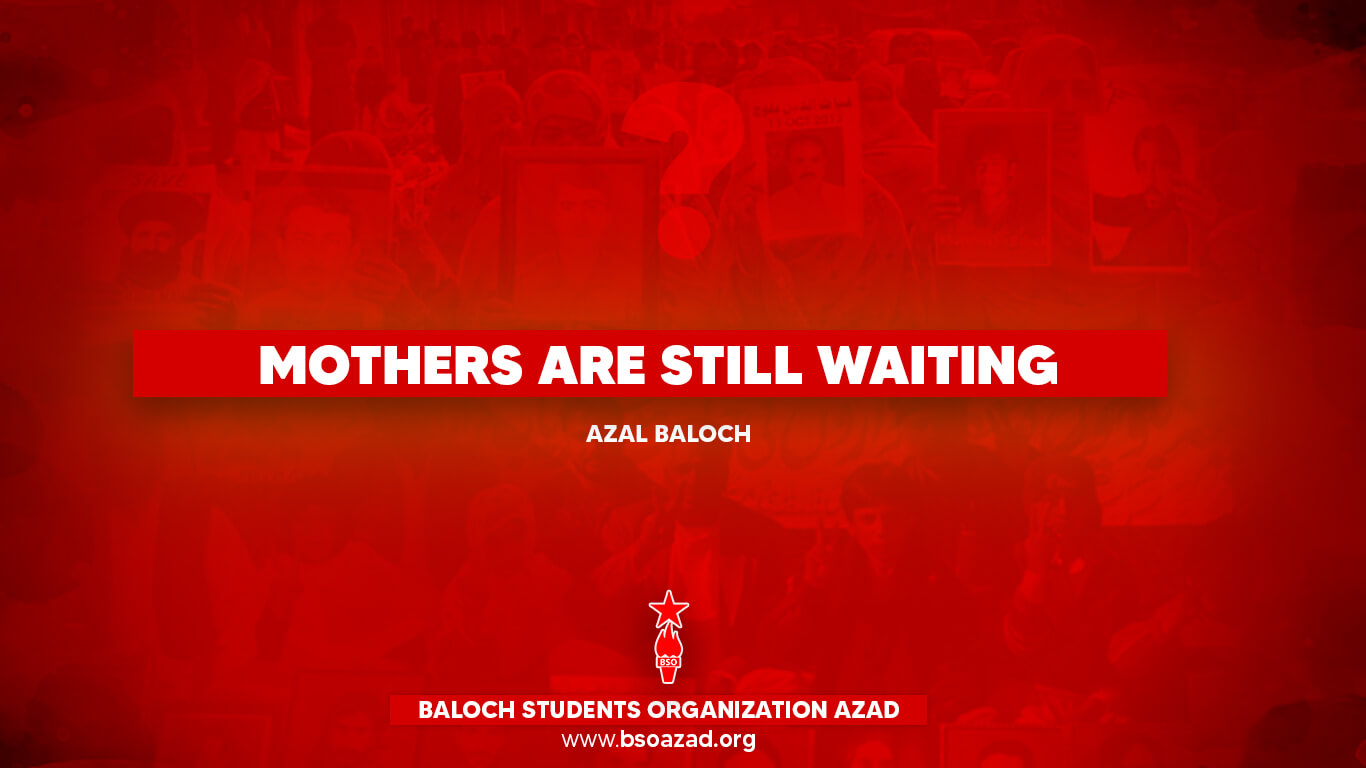
Mothers Are Still Waiting
Azal Baloch
A child still asks: “When is Baba coming home?”
8 June: Baloch Missing Persons Day
8 June is not merely a date on the calendar. It is the echo of a mother’s voice still calling the name of a loved one whose whereabouts remain unknown. Across Balochistan, this day is observed as Baloch Missing Persons Day. It serves as a reminder of those who have allegedly been subjected to enforced disappearance and highlights the continuing concerns regarding human rights violations in Balochistan.
This day is dedicated to all those whose families continue to wait for answers and justice. It is also a day to remember those who endured imprisonment, hardship, and suffering while remaining committed to their political beliefs and national aspirations.
Enforced Disappearance and International Legal Provisions
Enforced disappearance refers to the deprivation of liberty by state authorities or individuals acting with the authorization, support, or acquiescence of the state, followed by the concealment of the fate or whereabouts of the disappeared person. Such practices place individuals outside the protection of the law and deprive them of fundamental legal rights.
Historically, one of the earliest systematic uses of enforced disappearance was associated with Nazi Germany’s Night and Fog Decree (Nacht und Nebel Erlass) issued in 1941. The practice later gained notoriety during military dictatorships in Latin America throughout the 1960s and 1970s.
Enforced disappearances have severe consequences for both victims and their families. Relatives often spend years living in uncertainty, not knowing whether their loved ones are alive or dead. Victims face the risk of torture, extrajudicial execution, and prolonged detention, while families endure psychological trauma and social hardship.
The international community recognizes enforced disappearance as a grave violation of human rights. The International Convention for the Protection of All Persons from Enforced Disappearance, adopted by the United Nations General Assembly in December 2006, provides a legal framework to prevent and address this practice. The Committee on Enforced Disappearances (CED) monitors the implementation of the convention.
Similarly, the International Covenant on Civil and Political Rights (ICCPR) addresses enforced disappearance through various provisions, including:
* Article 6: Right to Life
* Article 7: Prohibition of Torture
* Article 9: Protection from Arbitrary Arrest and Detention
Numerous international human rights organizations, including Amnesty International and Front Line Defenders, have documented and campaigned against enforced disappearances across different regions of the world. International legal standards clearly regard enforced disappearance as a serious human rights violation and emphasize accountability for those responsible.
8 June and Its Historical Background
On 8 June 2009, Zakir Majeed, former Vice Chairman of BSO-Azad and a prominent Baloch political activist, was reportedly subjected to enforced disappearance. Seventeen years later, his whereabouts remain unknown, while his family continues to seek information regarding his fate.
In 2017, during a Central Committee meeting of BSO-Azad, 8 June was formally declared Baloch Missing Persons Day to raise awareness about enforced disappearances and to remember those whose whereabouts remain unknown.
For many around the world, 8 June may be an ordinary day. For the Baloch people, however, it symbolizes the suffering of countless families and the ongoing struggle for truth, justice, and accountability. It is a day to remember those who remain missing and to stand in solidarity with their families.
Enforced Disappearance, Mass Graves, and Extrajudicial Killings
Many activists and human rights organizations have linked enforced disappearances in Balochistan with reports of mass graves, extrajudicial killings, and the so-called “kill and dump” policy. Critics argue that these practices have been used to suppress political dissent and create an atmosphere of fear.
Over the years, students, activists, intellectuals, teachers, and political workers have reportedly been among those affected. The recovery of unidentified bodies and allegations of custodial killings have further intensified concerns regarding human rights in the region.
Some Notable Incidents
* January 2014: Mass graves were reportedly discovered in the Tutak area of Khuzdar. The incident attracted significant attention from local and international human rights organizations.
* 3 April 2009: Ghulam Muhammad, Sher Muhammad, and Lala Munir were reportedly abducted from Ghulam Muhammad’s law office in Turbat. Their bodies were later found in Murgaap.
* Ziarat Incident: Several individuals, including Shams, Shehzad Khuda Bakhsh, Salim Karim, and Dr. Mukhtar, were reportedly killed in what critics described as a fake encounter after previously being subjected to enforced disappearance.
The Story of Abdul Ghaffar Lango
On 11 December 2009, Abdul Ghaffar Lango, a Baloch political activist, was leaving a hospital in Karachi with his wife following her surgery when armed men in civilian clothing reportedly detained him near the hospital premises.
According to family accounts, he was assaulted, taken away, and his whereabouts remained unknown for an extended period. When relatives approached the police, they were allegedly informed that he had been detained because of his political activities, although no further information was provided.
On 1 July 2011, Abdul Ghaffar Lango’s body was reportedly discovered in an abandoned hotel near Gadani in Lasbela District, Balochistan. Reports indicated signs of severe torture on his body.
His case remains one of many cited by activists and human rights advocates when discussing enforced disappearances in Balochistan. Similar cases include those of Qamber Chakar, Ilyas Nazar, Sangat Sana, Kandeel, and Professor Saba Dashtyari.
The Resistance of Baloch Mothers and Sisters
Baloch mothers and sisters have played a prominent role in campaigns against enforced disappearances. Through protests, marches, sit-ins, and advocacy efforts, they have sought to draw attention to the plight of missing persons and their families.
Despite facing numerous challenges, they have continued to demand information regarding their loved ones and call for justice. Figures such as Banuk Kareema, the mothers of Zakir Majeed and Rashid Hussain, and many others have become symbols of resilience and perseverance.
Recent mobilizations, including long marches and public campaigns, demonstrate the continued determination of Baloch women to raise awareness about enforced disappearances and related human rights concerns.
Responsibilities of the Baloch Nation
History demonstrates that when communities face political marginalization and restrictions on their rights, demands for justice, dignity, and self-determination often emerge. In this context, it is the responsibility of the Baloch nation to continue raising awareness through peaceful political engagement, advocacy, writing, research, and public discourse.
The issue of enforced disappearances should be highlighted at national and international forums. Efforts should be made to document cases, support affected families, and challenge narratives that overlook or dismiss the concerns of victims and their relatives.
Conclusion
Enforced disappearance remains one of the most serious human rights concerns associated with Balochistan. Its impact extends beyond the individuals who disappear, affecting entire families and communities who continue to live with uncertainty and grief.
For the Baloch people, 8 June holds deep significance as a day of remembrance and solidarity. It is a day to remember those whose whereabouts remain unknown, to support their families, and to renew calls for truth, justice, and accountability.
The stories remembered on this day should not become the fate of future generations. As 8 June is observed, it remains a reminder of the ongoing struggle against enforced disappearances and the resilience shown by the families who continue to seek answers.